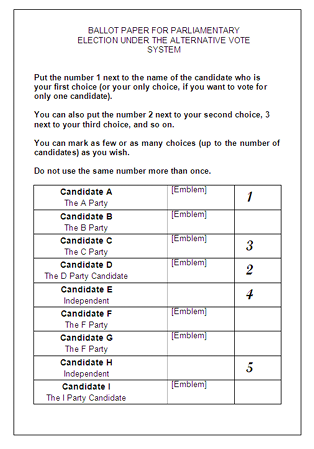
Like First Past the Post, the Alternative Vote system is based on single-member constituencies; but instead of voting for a single candidate with an ‘X’, voters rank candidates in order of preference, 1, 2, 3 …etc. Voters can cast as many votes as they choose

In round one, if more than half the voters have the same favourite candidate, that person becomes the MP.

If no candidate has more than 50 per cent of the votes, the candidate with fewest votes is eliminated and their votes are redistributed among the other candidates according to voters’ second preferences. The process continues until one candidate achieves a majority (50 per cent of the vote plus 1).

Labour Party members will be familiar with AV, as it is the system used to elect the leader of the Labour Party.When used for electing an individual to a single position - a party leader, a president, etc. it gives people the opportunity to vote according to their genuine preference, in the knowledge that if their preferred candidate is eliminated, their second or subsequent preference will still count.

AV does remove the need for tactical voting, but it is not a proportional system. This is due to its use of  existing constituencies with no "top-up" or balancing mechanism to ensure seats won are closer to the votes cast at a national level. 

Where is this system used?  Australia for the Lower House, House of Representatives and the US State of Maine. It is used to elect the President of Ireland.

It was also the system put to the British people in a referendum in 2011. If anyone tells you we've already had a referendum on PR - we had a referendum on AV.

> Pros and cons of AV
> More detail about AV

Back to voting systems homepage