Funding Political Parties
by Rick Gaehl
The most expensive General Election in UK history was the election of 1880. It cost somewhere in the region of £1.6 million [1] which, at current prices, equates to a mind-boggling £270 million. It came just eight years after the introduction of the secret ballot, intended to curtail corruption, coercion, and bribery in the conduct of elections, and not that long after the Second Great Reform Act of 1867, which had doubled the franchise to two million voters.
Clearly, more action was needed, and the Corrupt and Illegal Practices Prevention Act of 1883 was the solution adopted. This criminalised acts of electoral corruption and standardised the types and amounts of expenditure that were allowable. With only minor adjustments, this approach held good for pretty much the whole of the following hundred years, culminating in the last major update and consolidation of UK election rules in the Representation of the People Act of 1983.
During the 1990s, the long-established checks and balances began to unravel. Things started to go seriously awry, and a series of corruption scandals, including the notorious ‘cash for questions’ revelations, allowed an atmosphere of ‘sleaze’ to descend over Westminster. This led to the 1998 report from the Committee on Standards in Public Life which proposed the broad framework for regulating political finance that still operates today. Following this report, the Political Parties, Elections and Referendums Act of 2000 (PPERA) established the Electoral Commission, laid down accounting requirements for political parties, and introduced controls on donations.
As good an idea as the Electoral Commission was, its powers have never really been sufficient to keep election spending in check. Not only were the maximum punishments available to it for wrongdoing woefully out of alignment with the potential gains to be had, but the Elections Act of 2022 further reduced both its powers and its independence, whilst simultaneously raising the ceiling for donations.
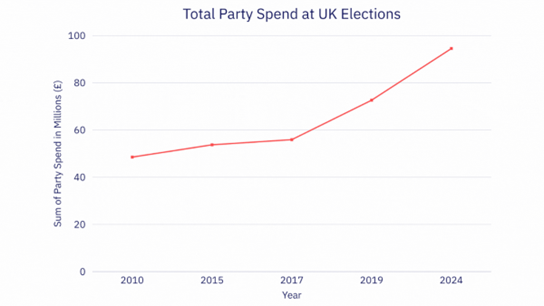
Once the figures were in, it became clear that the 2024 general Election was easily the most expensive in recent history, with a combined spend of £94.5 million [2]. However, there has been a rising trend over recent elections, and this was just a continuation of that trend [3]:
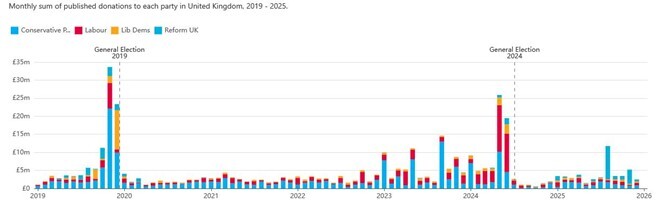
Political parties obtain their funding from a number of sources. Around 10% comes from the public purse, although the lion’s share of this (known as ‘Short’ money) only goes to parties in opposition. Some comes from membership and affiliation fees, although this is more important for the Labour and Green Parties than for others. But the bulk of income is in the form of gifts and donations, and although the general trend here is upwards there are significant shifts between party donations from one year to the next, and as you might expect, there are also major peaks in election years [4]:
Party funding is a complex and thorny issue, and there is probably no simple or universally acceptable way of regulating it. Clearly, if donations (especially large ones) are too easy to make, there is a chance of influence being seen as going to the highest bidder, and there is plenty of evidence that voters already think this is happening. The perceived threat to democratic institutions is even higher if donations are allowed (as they currently are) from foreign or hidden sources.
It seems unlikely that the cost of doing politics is going to decrease much in the future, and the alternatives to donor funding are neither numerous nor without their drawbacks. Public funding of political parties is likely to encounter resistance on cost grounds, and would, in any case, tend to exclude insurgent parties. Increased funding through subscription and membership fees would be difficult to introduce at scale and would leave members with a much stronger voice in policy formation, which sounds fine until you remember how deeply-felt and intransigent the views of party members can be.
All in all, what we can probably expect is a continuing reliance on a mixed ecology, with public funding, subscriptions, and donations all playing a part. What will be essential though is to ensure that all donations are made transparently, and by UK-domiciled individuals or organisations. This will mean restricting the list of permissible donors, and probably some types of more opaque donation (such as cryptocurrency). It would also mean putting a realistic cap on single donations. The fact that individual donations in the millions of pounds per year is even possible is just plain crazy.
Rick Gaehl serves on the LCER Executive Committee as Communications Officer

