Single Transferable Vote (STV) 

LCER website entry ===========================================================================

Single Transferable Vote (STV) is a voting system based on multi-member constituencies*. Areas are significantly bigger than our current constituencies and voters elect a small team of representatives covering a whole town or county, rather than one MP. The team reflects the political make-up of the area. The more seats a constituency has, the smaller the share of votes a party needs to win a seat, therefore smaller parties are more likely to win representation in larger constituencies.

Larger constituencies mean more proportional results, but necessarily cover a larger geographic area and are criticised for being more distant from voters and weakening the constituency link.

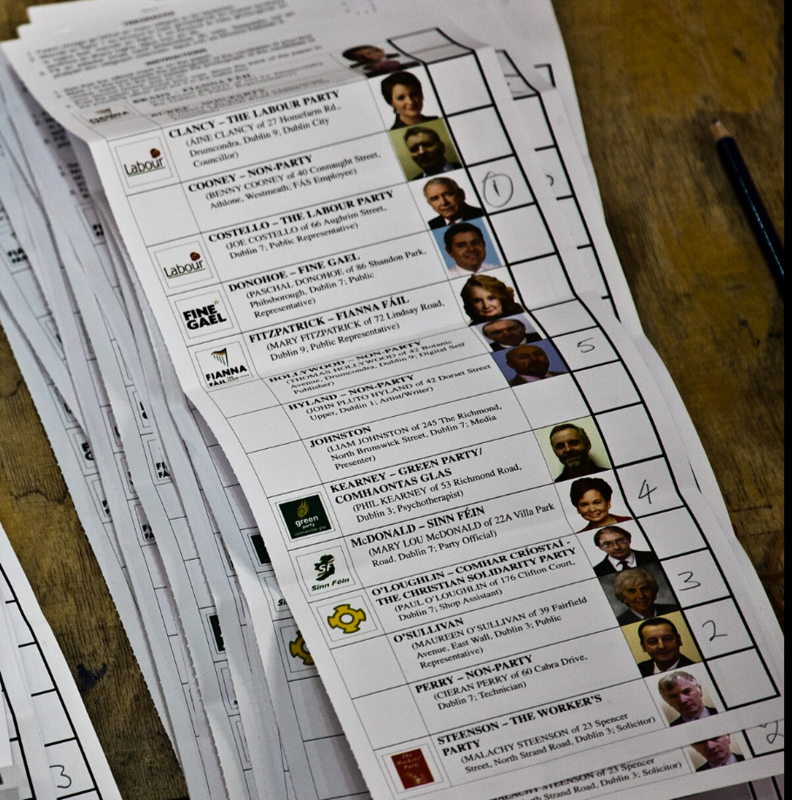
In Ireland, which uses STV, constituencies each have between 3 and 5 MPs. Each party nominates a list of candidates, and voters rank the candidates in order of preference - it is possible for voters to "mix and match" candidates from different parties.

At the count, candidates who reach the necessary "quota" (the number of voters divided by the number of seats +1) are automatically elected; where candidates have more votes than they need to secure election, their surplus votes are transferred to other candidates, according to second and subsequent preferences of the people who voted for the winning candidate.

When this procedure produces no more winning candidates, the lowest-scoring candidate is eliminated (as in the Alternative Vote system) and their votes transferred to other candidates according to second and subsequent preferences. The allocation of seats, transfer of seats and elimination of losing candidates continues until all available seats have been allocated.

This reallocation of votes means that STV does very well at minimizing "wasted" votes, both votes cast for losing candidates and surplus votes cast for candidates who win easily. However, as STV is generally used in smaller electoral districts it does not always guarantee the same proportionality as systems which use larger districts, and in a democracy where many political parties are active, smaller parties may be at a disadvantage similar to their experience under First Past the Post.

Where is this system used? STV is used in the Republic of Ireland, Northern Ireland (except for Westminster elections), Malta, Cambridge Massachusetts and for Senate elections in Australia. It has been used for Scottish local elections from 2007 and was recommended by the Sutherland Commission for local elections in Wales. STV was used widely in the US until it resulted in a communist being elected in New York during the McCarthyera. Used for Scottish Educational Authorities until to abolition in 1929, and University seats for the Commons until 1950.

* constituency size is an important consideration in STV - see “More Detail - STV” doc

==========================================================================

Pros

Wasted votes are minimised as both surplus votes and votes for losing candidates are redistributed

Proportional system - mostly works very well to match party seats and votes so long as the constituencies are large enough  (more proportionate with larger constituencies)

Voters more likely to have an MP for whom they have voted for than under FPTP

high level of voter choice. - voters can choose between candidates of the same party 

Potential to express intra-party preferences (candidates from different traditions within a party available to choose on the same constituency list)

Offers voters the chance to choose popular candidates  rather than simply their preferred party (not choosing unpopular candidates that parties have put forward). 

Group of representatives reflect the diversity of opinions in the area (true for any PR system)

Voters can vote for independent candidates without worrying about wasting their vote

It is a system where people use local knowledge to judge individual candidates at local level e.g for local government 

STV can offer protection against extremist/populist parties If they don't get a quota, then they can only win by being attractive to supporters of other candidates. 

Cons:

Garret FitzGerald , twice Ireland’s Taoiseach, criticised STV. arguing the multi seat nature led to "excessive localism" -  because politicians of the same party competed against one another for votes, they were forced to act as glorified local ombudsmen/ errand runners rather than focusing on national policy. Both main parties supported a referendum to change from STV but the Irish people voted “No”. Other Irish politicians boast about their system.

STV can potentially lead to extremist parties or populist candidates gaining representation. But if a candidate gets a quota of first preferences, they'll be elected in almost any PR system (if a candidate gets a quota of first preferences, there is no democratic reason for arguing against their election) National party vote thresholds are used by some countries for added protection so a minimum vote is required to gain any representation) 

Even with large multi-member constituencies, some smaller constituencies will not represent all parties (for example, a three- or four-seat constituency in a five-party system).

The counting process in STV is complex and hard to explain to citizens, potentially endangering its legitimacy (but the process hasn’t been challenged, or its legitimacy endangered in practice)

In Northern Ireland STV has not had as much impact as hoped in encouraging voting across sectarian dividing lines.

Because it relies on transferred votes, it may promote bland “acceptable to all” policies

More Info:

More detail on STV here

More detail on General issues here

More detail on local representation here

Electoral Reform Society explanation: https://electoral-reform.org.uk/voting-systems/types-of-voting-system/single-transferable-vote/ 

Electoral Commission video https://www.youtube.com/watch?v=5xc4UB7Nj14 

Electoral Commission video Scottish local elections https://www.youtube.com/watch?v=M91jraoo6t8