Supplementary Vote (SV)
LCER website entry ========================================================================
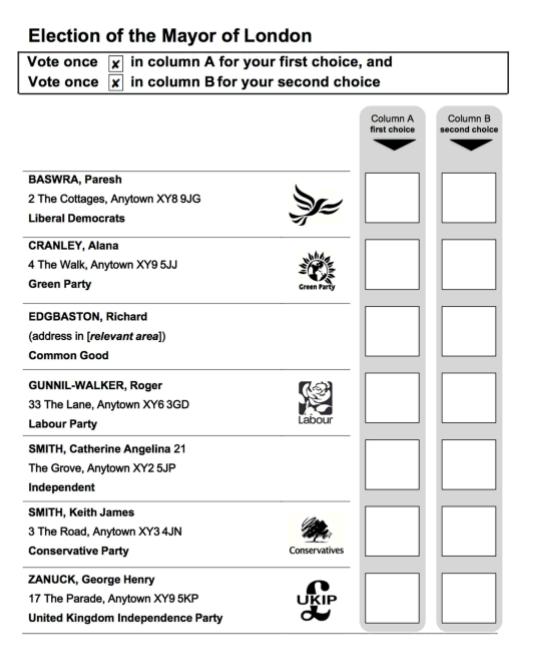
The Supplementary Vote system is similar to the Second Ballot system used for the French presidential election except that people vote for their first and second choices on the same day. The first choices are counted, the top two candidates remain in the race, and the second preferences of people who voted for eliminated candidates are then distributed between the top two remaining candidates.
Following the recommendations of the Plant Commission, this system was introduced in the UK under Labour for elected mayors and police and crime commissioners. It was favoured as it did not need a change to numbers or preferences but kept to X voting.
The Tories' 2022 Election Act reverted Mayoral elections to FPTP but the Labour government has now returned these elections to SV. Many argue that AV would have been a much better system for electing mayors as SV is designed for a two party system.
The aim of the SV system is to maximise the support for the winning candidate. If no candidate gets over 50% in the first round the winning candidate requires 2nd preferences of those eliminated to win.
However, with more than three candidates in the field, voters face the problem that they don't know for sure who the two candidates in the run-off round will be. Voters who cast both their first and second votes for candidates who are eliminated after the first round will effectively have no vote at all.
As with the Second Ballot system, SV is much better than FPTP for electing a single candidate. However, for parliamentary elections it is not a proportional system.
Where is this system used? UK Mayors (except 2023-26), Norway Mayoral elections and Sri Lanka uses a similar Contingent Vote system
===========================================================================
Pros
Politicians need a wider base of support than First Past the Post
SV stops candidates winning on low levels of support, but doesn't need them to get half the vote as a first preference (ERS)
Cons
It requires guesswork - voters need to guess who will get into the second round so they can maximise the chance of their second vote counting. This is worse in a multi-party context
If your second choice candidate does not make it to the "run-off" your second preference is wasted
Like FPTP SV was designed for two-party politics, it is not multi-party system
As SV only lets voters express two choices, in a multi-party situation many of the voters who cast a first choice for a candidate that doesn’t make the top two are also likely to cast their second choice for a candidate that is not in the top two, and so their vote will be wasted
In almost two decades of SV elections for the Mayor of London, only in 2016 has a mayor won with a combined first and second preference vote which is more than 50% of the total votes cast, as many second preference votes do not count
Little room for small parties to advance
"wrong winner" elections can happen as with FPTP e.g. Australia 1954 (AV) but this can happen under many voting systems
More Info:
More detail on General issues here
More detail on local representation here
Electoral Reform Society explanation: https://electoral-reform.org.uk/voting-systems/types-of-voting-system/supplementary-vote/
Electoral Commission video https://www.youtube.com/watch?v=ngaWCWZHFDA


