Single Transferable Vote (STV) is a voting system based on multi-member constituencies. Areas are significantly bigger than our current constituencies and voters elect a small team of representatives covering a whole town or county, rather than one MP. The team reflects the political make-up of the area. The more seats a constituency has, the smaller the share of votes a party needs to win a seat, therefore smaller parties are more likely to win representation in larger constituencies.
Larger constituencies mean more proportional results, but necessarily cover a larger geographic area and are criticised for being more distant from voters and weakening the constituency link.
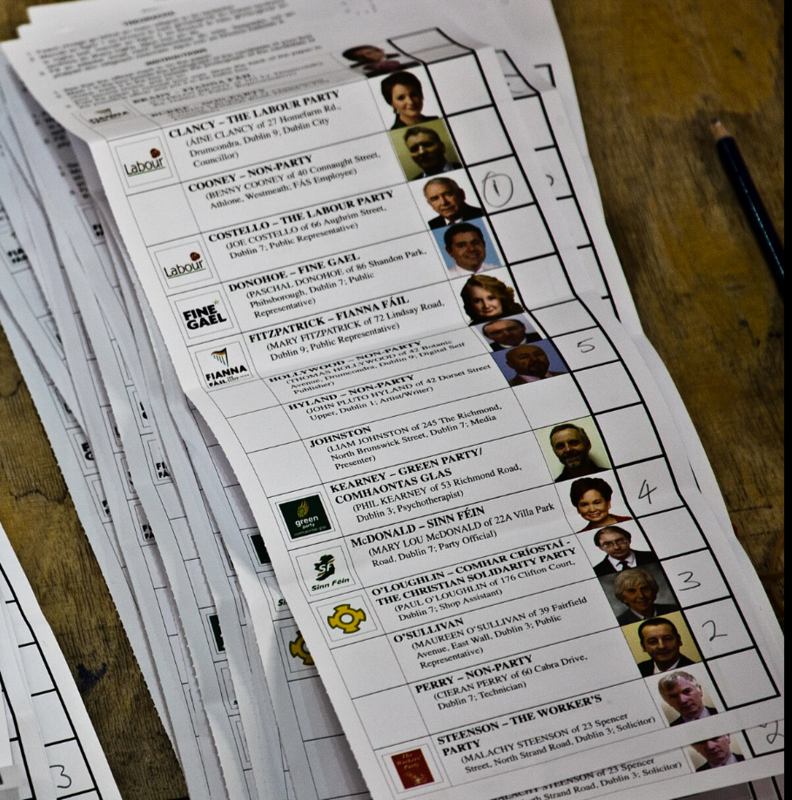
In Ireland, which uses STV, constituencies each have between 3 and 5 MPs. Each party nominates a list of candidates, and voters rank the candidates in order of preference - it is possible for voters to "mix and match" candidates from different parties.
At the count, candidates who reach the necessary "quota" (the number of voters divided by the number of seats +1) are automatically elected; where candidates have more votes than they need to secure election, their surplus votes are transferred to other candidates, according to second and subsequent preferences of the people who voted for the winning candidate.
When this procedure produces no more winning candidates, the lowest-scoring candidate is eliminated (as in the Alternative Vote system) and their votes transferred to other candidates according to second and subsequent preferences. The allocation of seats, transfer of seats and elimination of losing candidates continues until all available seats have been allocated.
This reallocation of votes means that STV does very well at minimizing "wasted" votes, both votes cast for losing candidates and surplus votes cast for candidates who win easily. However, as STV is generally used in smaller electoral districts it does not always guarantee the same proportionality as systems which use larger districts, and in a democracy where many political parties are active, smaller parties may be at a disadvantage similar to their experience under First Past the Post.
Where is this system used? STV is used in the Republic of Ireland, Northern Ireland (except for Westminster elections), Malta, Cambridge Massachusetts and for Senate elections in Australia. It has been used for Scottish local elections from 2007 and was recommended by the Sutherland Commission for local elections in Wales. STV was used widely in the US until it resulted in a communist being elected in New York during the McCarthy era. Used for Scottish Educational Authorities until to abolition in 1929, and University seats for the Commons until 1950.
More info:
> Electoral Commission video
> Electoral Commission video: Scottish local elections
Back to voting systems homepage

